

 Image 1 of 1
8 x 9 IN / 20.3 x 22.9 CM
36 Pages, 16 Plates
Softcover, Text in English
ISBN 979-8-9954405-3-6
Edition of 100
Part of the 36/50 Edition Series
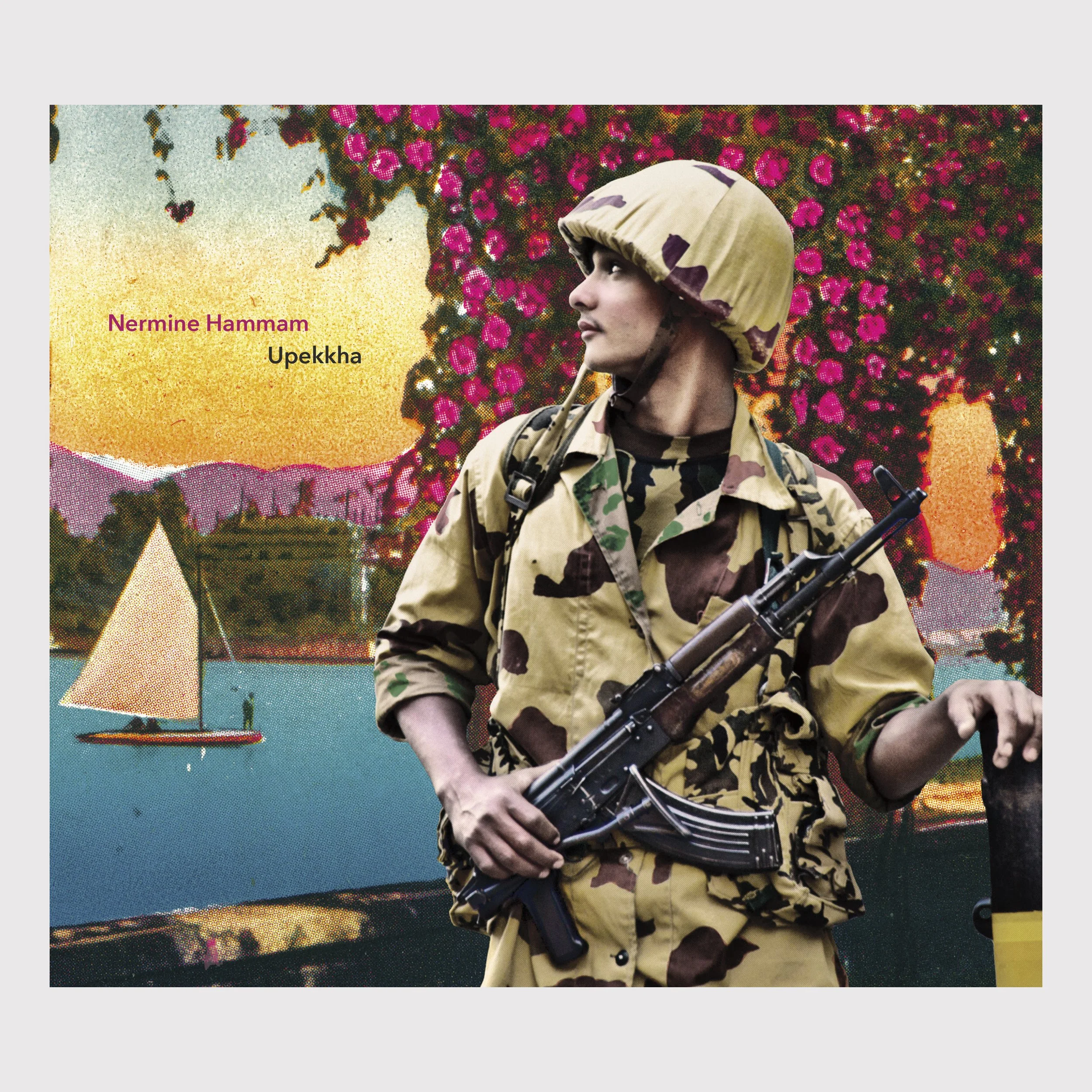
Upekkha was made in response to the events of the Egyptian revolution in January 2011. As the army entered Cairo and soldiers appeared among demonstrators in Tahrir Square, Nermine Hammam photographed young conscripts whose vulnerability stood in contrast to the familiar image of military power.
Hammam removes the soldiers from the streets of Cairo and places them against idealized landscapes drawn from old postcards. Mountains, lakes, flowers and saturated skies surround tanks, weapons and young men in military uniforms. The resulting images move between tenderness and force, beauty and unease, disrupting the visual language through which military authority is usually represented.
The title Upekkha refers to the Buddhist aspiration of experiencing the world through equanimity. Throughout the work, Hammam considers power as something constructed and performed—through uniforms, weapons, images and collective belief. The photographs ask what remains when the individual is separated from the spectacle of military power: young men who appear vulnerable, uncertain and human.
Edited and designed by Anthony Hamboussi
About the Author
Nermine Hammam (b. 1967, Cairo) is an Egyptian artist working between Cairo and London. Trained in filmmaking at New York University's Tisch School of the Arts, her practice encompasses photography, digital collage and mixed media. Her work examines the construction of images and their relationship to power, gender, militarism, memory and representation.
Hammam's work has been exhibited internationally, including at the Victoria and Albert Museum, London; Museum of Fine Arts, Boston; Louisiana Museum of Modern Art, Denmark; Institut Valencià d'Art Modern, Valencia; Musée du quai Branly, Paris; and The Mosaic Rooms, London. Her work is held in public collections including the Victoria and Albert Museum and the Tropenmuseum, Amsterdam.
8 x 9 IN / 20.3 x 22.9 CM
36 Pages, 16 Plates
Softcover, Text in English
ISBN 979-8-9954405-3-6
Edition of 100
Part of the 36/50 Edition Series
Upekkha was made in response to the events of the Egyptian revolution in January 2011. As the army entered Cairo and soldiers appeared among demonstrators in Tahrir Square, Nermine Hammam photographed young conscripts whose vulnerability stood in contrast to the familiar image of military power.
Hammam removes the soldiers from the streets of Cairo and places them against idealized landscapes drawn from old postcards. Mountains, lakes, flowers and saturated skies surround tanks, weapons and young men in military uniforms. The resulting images move between tenderness and force, beauty and unease, disrupting the visual language through which military authority is usually represented.
The title Upekkha refers to the Buddhist aspiration of experiencing the world through equanimity. Throughout the work, Hammam considers power as something constructed and performed—through uniforms, weapons, images and collective belief. The photographs ask what remains when the individual is separated from the spectacle of military power: young men who appear vulnerable, uncertain and human.
Edited and designed by Anthony Hamboussi
About the Author
Nermine Hammam (b. 1967, Cairo) is an Egyptian artist working between Cairo and London. Trained in filmmaking at New York University's Tisch School of the Arts, her practice encompasses photography, digital collage and mixed media. Her work examines the construction of images and their relationship to power, gender, militarism, memory and representation.
Hammam's work has been exhibited internationally, including at the Victoria and Albert Museum, London; Museum of Fine Arts, Boston; Louisiana Museum of Modern Art, Denmark; Institut Valencià d'Art Modern, Valencia; Musée du quai Branly, Paris; and The Mosaic Rooms, London. Her work is held in public collections including the Victoria and Albert Museum and the Tropenmuseum, Amsterdam.